Nano-grid Solar+Batteries
Newest "affordable" residential solar was
pioneered in Hawai'i, 2023-2025 on Moloka‘i.

Newest "affordable" residential solar was
pioneered in Hawai'i, 2023-2025 on Moloka‘i.
Nano-grids can deliver energy power at a lower cost to 200,000 not-yet-solar, low income households in Hawai'i. Nano-grids will soon be used in millions of homes throughout the United States who need an affordable solution to high electric bills. In Hawai'i the average roof-top solar installation can costs $60,000 compared to a Nano-grid with batteries that can now be bought at a retail store for about $5,000 and you can install it yourself. They are simple to use and can be installed in less than half an hour.
One of the nation's leading experts in Nano-grids is Hawai'i resident John Ogawa Borland, who came up with a concept for Nano-grid Solar in 2017. His project was first used in the recovery efforts after Hurricane Maria in Puerto Rico. With a grant from IEEE, Borland provided free Nano-grid systems to a dozen Native Hawaiian homesteaders on Molokai in 2023.
What is a Nano-Grid?
A Nano-grid allows a home or business to produce their electrical power onsite. A solar Nano-grid is a small, self-contained energy system that produces and manages its own power—typically under 100 kW—for a single home, building, or mobile unit. Combining solar generation, battery storage, and smart controls, it can operate autonomously off-grid or in tandem with the main utility grid.
Being energy self-sufficient offers multiple benefits. You are no longer effected by high electric utility costs. You gain resiliency from blackouts and brownouts.
Nano-grids are part of the solution to fixing Hawai'i''s and the rest of the nation's aging electric grid infrastructure. Adding nano-grids to a third of residences, will reduce the stresses on the existing grid, while utilities shifts to a cleaner renewable form of power.
Today we are experiencing more extreme weather disasters, power grid vulnerabilities, and increased demand for energy resilience. Nano-grids are the answer and they are gaining mainstream attention.


In September 2017, Hurricane Maria destroyed the electrical power grid in Puerto Rico. John Ogawa Borland's white paper on Nano-Grid Solar written five months earlier, resulted in Tabuchi (Japanese Equipment manufacturer) donating off-grid residential solar+battery systems to the island's recovery effort. Tabuchi's donation was based on the strength of Borland's proof-of-concept from April 2017.
John Ogawa Borland read an article in Civil Beat in 2021 that described energy inequality on the island of Molokai. About 8% of Molokai residents live without electricity. He wrote an energy cost analysis for residents on Molokai if they used nano-grids with battery storage. The Institute of Electrical and Electronic Engineers (IEEE) backed Borland with a grant to build nano-grid systems for a dozen Native Hawaiian homesteaders.
Nano-grids with battery storage were installed in 2023 and became known as the IEEE Moloka‘i Project.
A handful of Maui fire survivors copied the IEEE Moloka‘i model. Funding to build Nano-grid solar+battery systems on Maui came from the Rotary Club. The Rotarians donated $40,000 for Plug-N-Play backup battery generators, used solar panels, and hands-on technical training.

An IEEE member from the University of Washington Clean Energy Institute copied the Moloka‘i model. She worked with the local Tulalip Tribe. Washington state has abundant water and Hydro-power and the IEEE Molokai model is used in their energy system.
Additional Native Hawaiian Homesteads were added in 2025.
The Navajo Nation invited John Ogawa Borland to be an advisor for them on Nano-grid Solar+Batteries. He worked with the Hopi Tribe and Alliance for Tribal Clean Energy.
The Hopi tribe has 35% of its residents living without electricity and the Navajo Nation has 21%.
The Navajo Nation is the largest Native American reservation in the United States, spanning roughly 27,000 square miles with over 250,000 residents.

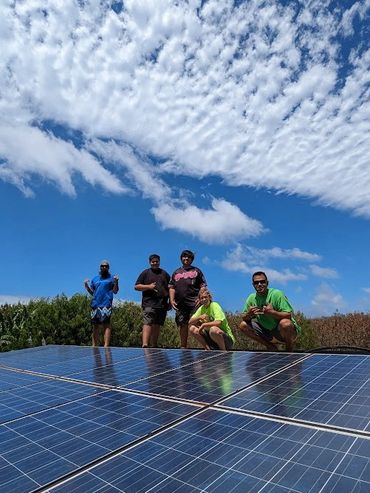
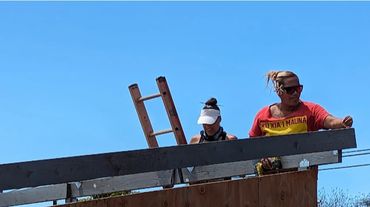
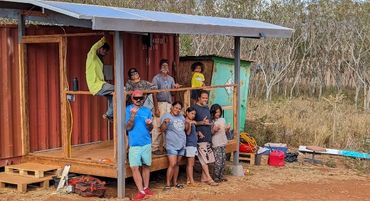
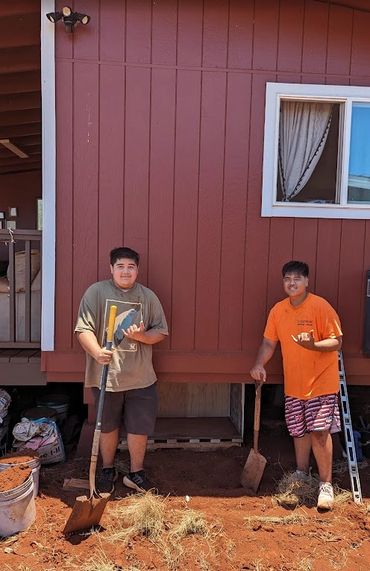
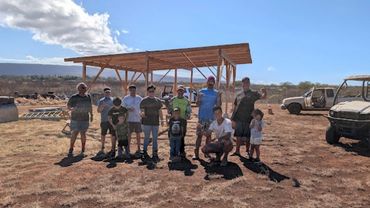
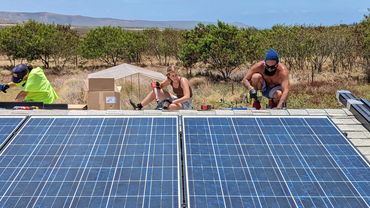
Poepoe Homestead Mini-MicroGrid and Nano-Grid Solar+Batteries Installation September 2023

Kekoa Homestead Installation March 2024
Todd Yamashita and Crew During Maikui Homestead Installation 2025.

The residential solar program in Hawaii has been very successful. Forty-five percent of single-family homes utilize rooftop solar- the “haves,” if you will. This has given the grid a severe duck curve due to excess daytime solar being exported. A high evening peak demand led to Hawaii ending its Net Energy Metering (NEM) program in 2015. Today, the state’s solar grid-export credit is 10¢/kWh (wholesale price).
There is a severe social-economic energy divide between the “haves” and “have-nots” in Hawaii. Rooftop solar households benefit from up to 92% energy cost savings and energy burden reduction. If everyone switches to Time-of-Use (TOU) rates and add Battery-Only as an overnight household appliance the “have nots” can reduce their HECO bill by 50% and charge their battery from excess daytime solar from the grid at the lowest TOU rates.
Among the hardest hit by a high energy burden are Native Hawaiian low-income families, who could see their energy burden reduced by up to 92%, a significant relief when living paycheck to paycheck.
The greatest energy insecurity and social inequity in Hawaii is on Molokai Island, where a Honolulu Civil Beat article in September of 2021 reported that 62% of residents there are Native Hawaiian and many live without a connection to the grid because of high electricity rates and connection fees.
“When the sun sets on Molokai, hundreds of homes go dark,” the article reads, “Forcing many families to choose between using power at night or feeding their children”.
This inspired John Ogawa Borland, lead author, to write his IEEE-PVSC 2022 paper, an energy cost analysis for residents on Molokai showing how island nano-grids can reduce energy burden by 95% for off-grid homesteaders and 45-65% for grid-tie renters without access to rooftop solar.
John Ogawa Borland's case study and IEEE Molokai pilot demonstration was the catalyst that kicked off several new businesses and a community cooperative using new nano-grid technology based on his design. He worked with Todd Yamashita the President of Ho'āhu on Molokai and PNNL. In 2022, Borland convinced them that a Community Solar system was not the best solution for Molokai and he published the economics. The Honolulu Star Advertiser published Borland's article and table showing the data for using Nano-Grid was more economical over Community Solar in February 2023.
Hearing what John Ogawa Borland accomplished on Molokai the Navajo Nation invited him to bring nano-grid solar + batteries to Arizona in 2025.
Molokai homestead residents did not have access to the electric grid.

John Ogawa Borland was raised in Honolulu, Hawaii and received his BS and MS degrees in Material Science and Engineering from MIT (Massachusetts Institute of Technology). BS thesis on InP Liquid Phase Epitaxy at Hughes Malibu Research Labs and MS thesis on InGaAsP Molecular Beam Epitaxy at Nippon Telegraph and Telephone Musashino Labs in Japan. He was an MIT scientist on NASA's Space Shuttle program at the Marshall Space Flight Center in Alabama. He has published 182 technical and invited papers in the areas of advanced semiconductor device manufacturing, high efficiency c-Si solar cells and residential Solar + Storage energy cost savings. He has also been awarded 6 US patents in the semiconductor industry and 2 Japanese patents in the solar industry. In June 1996, the press release of his third patent resulted in Genus' stock price one-day jump of 25%. In 2020, he published a book chapter on residential Island Nano-Grid using 100% Energy from the Sun.
He started his career in Silicon Valley working for National Semiconductor on 1.25um CMOS latch-up immunity and intrinsic gettering, then moved to Applied Materials developing advanced CMOS Si-deposition techniques (Epi, Selective Epi & Poly with interface control). At Genus he was Director of Process Development & Marketing, then VP of Strategic Technology developing W-CVD technology and high energy implantation for CMOS Twin and Triple Well technology which moved him back to the Boston area. Varian (VSEA) acquired Genus, he was Director of Advanced Business Development developing Ultra-Shallow Junction technologies for CMOS scaling.
In 2003 John Ogawa Borland moved back home to Aiea, Hawaii and founded J.O.B. Technologies, a strategic technical marketing consulting company providing services to the semiconductor industry in the area of advanced CMOS process technology now focused on the 3nm node CMOS technology. He was Director of Operations at Advanced Integrated Photonics’ Hawaii 150mm silicon photonics development Fab in 2013 and 2014. Interesting note is his patent on Triple Well CMOS technology was used to successfully counter a lawsuit against Samsung DRAM and Flash Memory manufacturing in 2020.
For the solar industry he developed high efficiency c-Si solar cells using ion implantation and laser melt annealing for selective emitter technology. Currently he is focused on residential Solar + Storage to Fight Climate Change by bringing Energy Equity to the underserved communities. This involves home energy usage audit to ID options to reduce energy burden and maximize energy cost savings.
John Ogawa Borland secured humanitarian project funds in 2022 from the Institute of Electrical and Electronics Engineers (IEEE) to build a pilot demonstration on Molokai. The IEEE Molokai humanitarian project that he designed trailblazed nanogrid solar on Molokai. John Ogawa Borland is a senior member of IEEE, the IEEE Region 6 Central Area chair, past-chair of the IEEE Hawaii section, IEEE Electron Device Society/Solid-State Circuits Society Hawaii chapter chair and IEEE Power and Energy Society Hawaii chapter chair. He is also a member of the Electrochemical Society and Materials Research Society.
The IEEE Molokai project inspired the rebuilding effort on Maui after their 2023 wildfires. The pilot off-grid system designed by John Ogawa Borland for Molokai homesteaders was adapted and used on Maui by their fire survivors.
John Ogawa Borland was invited in 2025 to share his innovative nano-grid solar design with the Navajo Nation in Arizona. The Hopi tribe has 35% of its residents living without electricity and Navajo Nation has 21%. Molokai has only 8% of its residents living without electricity.

JOHN OGAWA BORLAND - 6 US Patents, 2 Japanese Patents.
FIRST PATENT: 1990
LATEST PATENT: 2023
John Ogawa Borland graduated from Radford High School in Honolulu, before earning two degrees from MIT (Massachusetts Institute of Technology). In Silicon Valley he designed equipment used in the fabrication of semiconductor chips. In 1996, Borland was Vice President of Strategic Technology at Genus when a press release of Borland's patent award resulted in a one day jump in Genus' stock by 25%.
John Ogawa Borland has published over 184 technical and invited papers around the world. His two Japanese patents on Solar energy shifting and sharing issued in 2022 and 2023 are being used in the 2023 IEEE Molokai Humanitarian project for Native Hawaiian Homesteaders in giving Energy Equity and access to the internet to rural families who were living off the grid.
His Molokai project provided power to 18 Native Hawaiian families. Nano-grid Solar+Batteries were given to 13 families living off-grid and five families grid-tied to HECO.
John Borland said the "solar industry is 30 years behind the semiconductor industry" and he is focused on developing new solar technologies needed to fight climate change.
His Solar Inventions are battery electrical storage and thermal storage. Working with Japanese manufacturer Tabuchi Electric he invented cold thermal battery storage for air conditioning and hot thermal battery storage for hot water.


